
'Slippery as hell' in Mexico: Verstappen and Hadjar explain the 'extreme' altitude challenge of the 2026 era
मेक्सिको सिटी ग्रां प्री 2026 में मैक्स वर्स्टापेन और इसाक हदजार ने ऑटोड्रोमो हर्मानोस रोड्रिगेज को "नरक जैसी फिसलन" और सप्ताहांत को "अतिवादी" बताया। वजह: सर्किट समुद्र तल से 2,286 मीटर ऊपर है, जहां हवा का घनत्व सामान्य से लगभग 22-28% कम हो जाता है — इससे डाउनफोर्स और कूलिंग, दोनों घटते हैं। 2026 के नियमों ने ऊंचाई की दोनों पारंपरिक राहतें खत्म कर दी हैं: सक्रिय एयरोडायनामिक्स के कारण अब व्यावहारिक रूप से एक ही विंग स्पेसिफिकेशन चलता है, और MGU-H हटाए जाने से टर्बो को इलेक्ट्रिक मदद नहीं मिलती, जिससे लैग बढ़ता है। नतीजा — प्रदर्शन का केंद्र धीमे, ट्रैक्शन-सीमित कोनों, मैकेनिकल ग्रिप और ब्रेक स्थिरता की ओर खिसक गया है। असली अड़चन लैप टाइम नहीं बल्कि कूलिंग है; टीमें अधिकतम कूलिंग एग्ज़िट खोलकर चलेंगी और ड्रैग की कीमत चुकाएंगी, क्योंकि ऊंचाई पर ड्रैग सस्ता पड़ता है। नई बिछाई गई सतह कागज़ पर ग्रिप बढ़ाती है, लेकिन उसका विकास अरैखिक है और जल्दी सेटअप तय करने वाली टीमों को नुकसान पहुंचा सकती है। सबसे बड़ी अज्ञातता रेड बुल फोर्ड की है — पहले सीज़न में पहला ऊंचाई वाला इवेंट, जिसके पास कंप्रेसर मैप और टर्बो स्पीड लिमिट कैलिब्रेट करने का ऐतिहासिक डेटा नहीं है; पतली हवा में टर्बो को मैकेनिकल सीमा के करीब चलाना पड़ सकता है, जो विश्वसनीयता जोखिम है और इसे ड्राइवर नहीं सुधार सकते। वर्स्टापेन का RB22 की धीमी-गति कमज़ोरी वाला बयान उनके ही सिंगापुर जीत और मोनाको फ्रंट रो के विपरीत है — यह अपेक्षा-प्रबंधन है। रणनीति में ग्रिड पोज़िशन प्राथमिकता पर रहेगी, क्योंकि कम ग्रिप और कमज़ोर टो के कारण ओवरकट का लाभ घटा है; सेफ्टी कार की ऊंची संभावना सबसे बड़ा वैरिएंस और मिडफील्ड के लिए सबसे बड़ा अवसर है। जॉर्ज रसेल ने संकेत दिया कि फेरारी का छोटा टर्बो ऊंचाई पर बढ़त दे सकता है — तकनीकी रूप से तर्कसंगत, पर प्रतिद्वंद्वी द्वारा सार्वजनिक रूप से कहा गया, इसलिए अपेक्षा-स्थानांतरण भी हो सकता है। निष्कर्ष: ऊंचाई 2026 सीज़न का सबसे बड़ा डी-कोरिलेटिंग चर है, इसलिए मेक्सिको के नतीजे को सीज़न-स्तरीय आकलन में बहुत कम भार दिया जाना चाहिए।
Mexico City: Formula 1's 2026 Mexican Grand Prix does not begin on Friday. On Thursday's media day it was already clear that the weekend's biggest rival is not another team but the geography of the Autódromo Hermanos Rodríguez. The language used by the two Red Bull-affiliated drivers, Max Verstappen and Isack Hadjar, went well beyond rhetorical flourish. Verstappen called the surface "slippery as hell" and the weekend "extreme"; Hadjar warned that if the cooling maths does not work out, "everything is going to be on fire".
This is not merely driver complaint. The 2026 rule cycle has simultaneously removed the two traditional reliefs teams relied on at altitude circuits — and that is the single most important technical fact of the weekend.
2,286 metres: physics offers no compromise
Mexico City sits roughly 2,286 metres above sea level. At that altitude, air density falls to somewhere between 72 and 78 percent of sea level depending on ambient temperature — meaning the mass of air that generates both downforce and cooling drops by 22 to 28 percent. The direct consequence: the wing stays the same, but its effect shrinks. Teams would normally trim from Monaco-style high-downforce wing levels towards Monza-style low-downforce levels just to claw back some downforce in thin air.
Before 2026, that altitude problem was manageable because teams had at least two reliefs. First, a wide wing-trim window that recovered downforce. Second, the MGU-H, which electrically pre-spooled the turbocharger and masked the lag created by thin air.
2026 removed both reliefs at once
Active aerodynamics has effectively collapsed the wing-trim window. In practice teams now run essentially one specification — in the drivers' words, "now you basically just run one wing". On the other side, the MGU-H has been legislated out, meaning the turbo now spins purely on exhaust gas pressure. To achieve the same absolute intake pressure in thin air, the turbo must spin faster, which increases lag and delays power delivery out of slow corners.
This is not a setup preference but a structural, regulation-induced double-bind. It is precisely why Verstappen identified a clear shift in the performance emphasis — mechanical grip, suspension compliance, braking stability and traction in slow corners are now decisive.
The binding constraint is cooling, not lap time
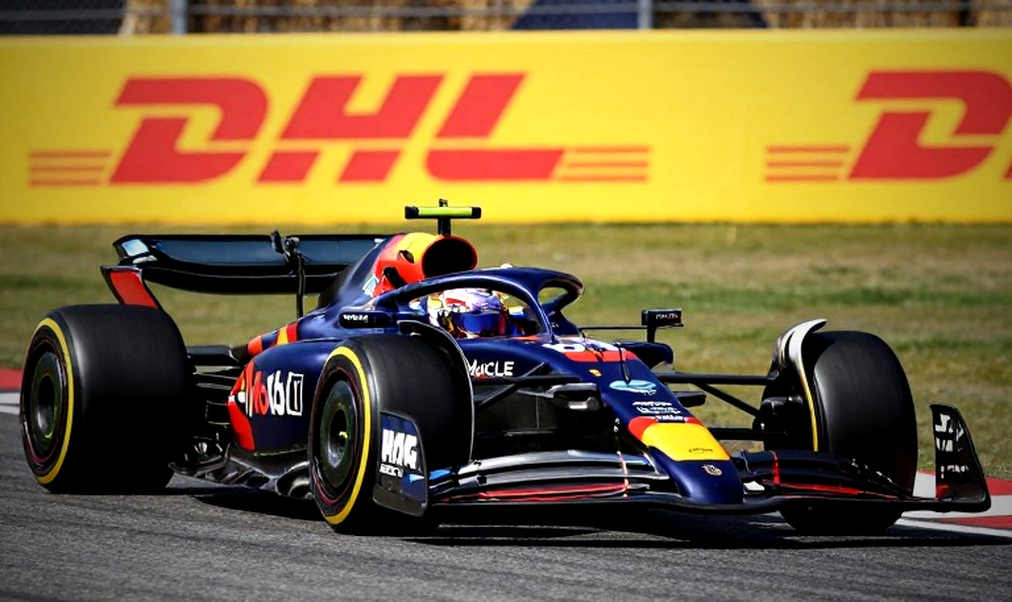
The sharpest effect of thin air will probably not be on outright pace but on thermal management. The mass flow reaching radiators, brake ducts and the engine-turbo installation is reduced, so teams will run maximum cooling louvres and exits. That means a clear drag penalty — but drag is cheap at altitude, so teams will happily pay it. Hadjar's "everything is going to be on fire" is hyperbole, but directionally correct. If brake or power unit temperatures impose a stint-length limit, strategy will be dictated by thermal budgets rather than tyre life.
A new surface cuts both ways
The track has been resurfaced, which should "supposedly offer more grip" and partially offset the altitude downforce loss. But new asphalt does not behave linearly — bitumen leaches in the early sessions, grip evolves rapidly, and any team that locks in a setup during FP1 or FP2 may pay heavily later. Verstappen's "slippery" description is a direct signal of that uncertainty: more grip on paper, an unstable balance in practice.
Red Bull Ford's unknown unknown
The biggest unknown this weekend belongs not to a driver but to a power unit. As Red Bull Ford, this manufacturer is in its first season and this is its first altitude operation. Mercedes, Ferrari and Honda have years of altitude datasets to calibrate compressor maps, charge-air cooling and turbo speed limits against. Red Bull Ford has no such historical baseline.
The most serious technical exposure is that achieving the same absolute intake pressure in thin air may require running the turbo far closer to its mechanical limit. That is a reliability risk no amount of driver skill can mitigate. Verstappen himself conceded there is little the drivers can do — and made clear that "lower gears to keep revs up" will not solve it. That statement is technically significant: this is a compressor/spool problem, not a gearing problem, and its solution sits entirely with the power unit engineers.
Verstappen's deliberate expectation management
Verstappen said the RB22 "does not really excel" in low-speed corners. Yet a contradiction emerges from his own record: he won Singapore, a wholly low-speed circuit, and put the car on the Monaco front row before major upgrades. The very weakness he cites ahead of a weekend where slow corners matter most is contradicted by his results. This is textbook expectation management rather than technical reporting; analysts should discount the pessimism.
For Hadjar this weekend is diagnostic, not results-based
Hadjar noted that "last year, I already felt...", indicating a sophomore season with limited F1 mileage. A young driver, a new low-grip surface, a reduced downforce package and turbo lag is the highest-risk combination for overdriving and error accumulation. His candid "slipping and sliding" description is commendable but also signals limited confidence in the car's control margin. Surviving a high-attrition event without a heavy crash is itself a de facto performance metric for a young driver.
Strategy: grid position first, tyres second
The central strategic question is the qualifying-versus-race-pace trade-off. Low grip and weakened slipstream — tow also scales with air density — reduce the payoff of a fast-car-in-clean-air overcut. The priority is obvious: start ahead.
The second major factor is Safety Car probability. Mexico traditionally produces elevated SC and red-flag rates through the Turn 1–3 concertina and the stadium section. On a low-grip, high-attrition weekend, SC timing is the biggest opportunity for midfield teams — far more than raw pace.
Another under-analysed factor is the start. With "a lot less downforce" and a resurfaced low-grip surface, launch performance and surviving the first three corners may shuffle more positions than pit strategy. Teams with the weakest low-speed traction will be forced into earlier stops — not an opportunity, but a strategy imposed by car characteristics.
Russell's Ferrari gambit
The most competitively loaded statement comes from George Russell, who implied Ferrari's smaller turbo could give it an altitude advantage. Technically this is a legitimate hypothesis: lower rotational inertia means faster spool and less lag out of slow corners. But who is saying it? A rival, publicly, at the very circuit where lag matters most. It could be genuine technical respect or a deliberate attempt to shift expectations onto Ferrari; the article does not resolve which. Note the known trade-off: lower inertia improves spool but typically constrains peak compressor flow, i.e. top-end power. If Russell is right, the corollary is that Mexico may flatter Ferrari relative to its true season-level competitiveness.
Hadjar took the opposite stance: "I'm not thinking about Ferrari or Mercedes... why not here?" For a team whose power unit has no altitude history, that is a rational risk-off statement — reframing an unknown as an opportunity.
Regulatory context and conclusion
Under the 2026 technical regulations, power unit homologation and the cost cap limit altitude-specific hardware development; maximum cooling bodywork is essentially the only free variable. No grey-area design has been alleged, so compliance risk is low to medium.
The real point is that altitude is the 2026 season's most de-correlating variable — the one circuit characteristic that cannot be reproduced in a wind tunnel, on a sea-level-calibrated dyno, or in a simulator. Mexico's result should therefore carry very little weight in season-long competitive judgement. It is an outlier weekend, and reading it as a competitive shift would be a mistake. The team that looks fastest on Friday need not be fastest on Sunday — because the winner here will be whoever makes the fewest errors in the triangle of thin air, a slippery surface and hot brakes.