
At the First Commonwealth Kabaddi Championship, India's Real Opener Is a Nine-Day Calendar
**मुख्य उत्तर:** भारत का पहला मुकाबला महिला वर्ग में 23 अक्टूबर 2026 को मलेशिया से और पुरुष वर्ग में इंग्लैंड से होगा। यह पहला कॉमनवेल्थ कबड्डी चैंपियनशिप है, जो अहमदाबाद में 23-31 अक्टूबर तक चलेगी। **मुख्य तथ्य:** • 13 देशों की 23 टीमें नौ दिनों में 62 मैच खेलेंगी; 39 पुरुष और 23 महिला मुकाबले हैं। • भारतीय पुरुष टीम के कप्तान सुरजीत सिंह और उपकप्तान नवीन कुमार हैं। • महिला टीम की कप्तान निधि शर्मा और उपकप्तान रितु हैं। • सेमीफाइनल 30 अक्टूबर 2026 को और फाइनल 31 अक्टूबर 2026 को होंगे। • आयोजन AKFI कर रहा है, IKF की मंजूरी से; अहमदाबाद 2030 कॉमनवेल्थ गेम्स की मेज़बानी की तैयारी में है। **स्रोत:** कॉमनवेल्थ कबड्डी चैंपियनशिप पूर्वावलोकन, 22 अक्टूबर 2026। **संबंधित प्रश्न-उत्तर:** Q: भारतीय पुरुष टीम का पहला मुकाबला कब और किससे है? A: 23 अक्टूबर 2026 को रात 8:30 बजे इंग्लैंड से। Q: भारतीय महिला टीम का पहला मुकाबला कब और किससे है? A: 23 अक्टूबर 2026 को शाम 6:45 बजे मलेशिया से। Q: टूर्नामेंट में कुल कितने मैच हैं? A: 62 मैच, जिनमें 39 पुरुष और 23 महिला वर्ग के हैं।
Ahmedabad's Veer Savarkar Sports Complex will hear its first whistle at 11:00 AM on October 23, 2026. Kenya and Singapore will open the inaugural Commonwealth Kabaddi Championship in a men's Group B match. India, the host, will not be on the mat. The women's team will face Malaysia at 6:45 PM; the men's team will meet England at 8:30 PM. Three clocks in one day: the first match, the first home fixture, the first headline fixture. I built a raid tracker for a U-17 final nobody asked me to track. The same habit asks a simpler question here: 23 teams from 13 nations, nine days, 62 matches—an average of 6.9 matches a day. India's first real opponent, before Malaysia or England, is the calendar. The scoreboard said guaranteed. The calendar said wait.
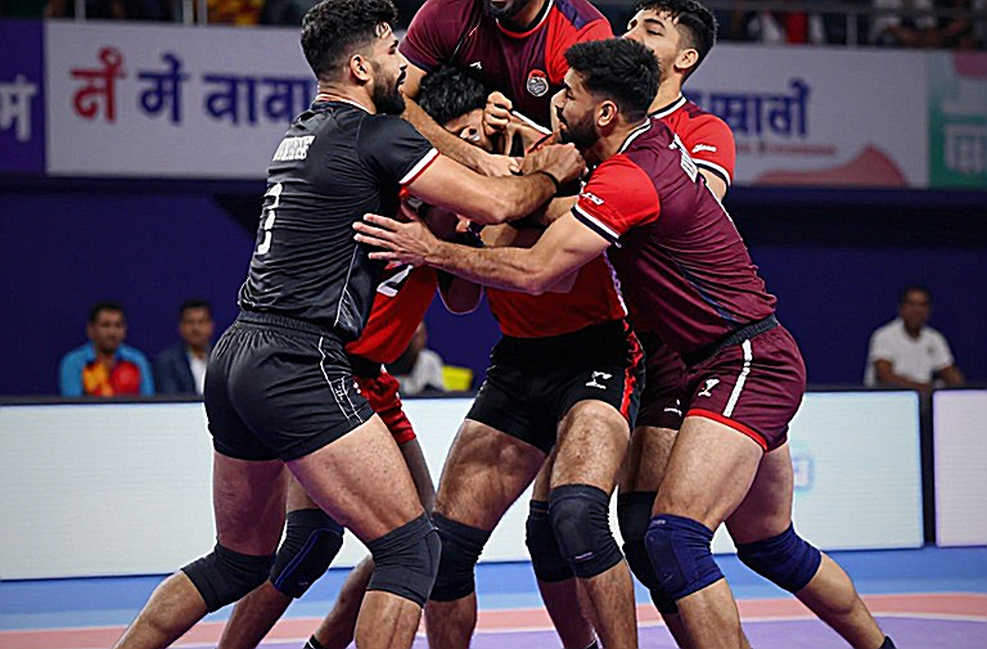
The tournament is organised by the Amateur Kabaddi Federation of India with approval from the International Kabaddi Federation. It is the first Commonwealth Kabaddi Championship, and Ahmedabad is preparing to host the 2030 Commonwealth Games. That makes the nine-day event more than a new trophy. The men's competition has 13 teams in two groups. India are in Group A with Nigeria, Malaysia, Uganda, England, Tanzania and Sri Lanka; Group B has Bangladesh, Kenya, Canada, Australia, Scotland and Singapore. The women's competition has 10 teams in two groups of five. India share Group A with Singapore, Nigeria, Uganda and Malaysia; Group B contains Bangladesh, Kenya, England, Scotland and Sri Lanka.
Surjeet Singh captains the Indian men's team, with Naveen Kumar as vice-captain. The 14-member squad also includes Sachin Tanwar, Pankaj Mohite, Bharat Hooda, Shubham Shinde and Parvesh Bhainswal. Nidhi Sharma captains the women's team, with Ritu as vice-captain; Muskan Sharma, Riya Kumari, Simran Kamboj and Karthika Ramesh are in the squad. The men open against England on October 23, then face Uganda on October 24, Malaysia on October 25, Nigeria on October 26, Tanzania on October 27 and Sri Lanka on October 29. The women face Malaysia on October 23, Singapore on October 24, Uganda on October 25 and Nigeria on October 26. The top two teams in each group reach the semifinals on October 30; the finals are on October 31.
Look at the group arithmetic. The seven-team men's Group A alone produces 21 matches; the six-team Group B produces 15. The men's 39 fixtures break down into 36 group matches, two semifinals and one final. The women's two groups of five produce 20 group matches, two semifinals and one final—23 fixtures. That arithmetic places the load of 62 matches in nine days on the whole operation, not on India alone.
Now open the ledger the scoreboard does not show. India's men have six group matches in seven days—October 23, 24, 25, 26, 27 and 29. October 28 is the only full rest day. India's women have four matches in four days—October 23 to 26. Before the semifinals on October 30, the women get three days; the men get one. That gap is not small.
Kabaddi turns a raider's body into repeated bursts of acceleration, deceleration, direction change and contact; a defender absorbs force. Four matches in four days and six in seven days are different physical pressures. A 14-player squad means seven on the mat and seven for rotation. Every player is not the same. India have names recognised from the Pro Kabaddi League, yet the question here is whom the captains rest, and when. The result against England and Malaysia on day one will do more than add a win or a loss; it will decide whether India can afford to rotate on day two. A win opens rotation. A defeat closes it.
India's men have 14 names, but seven players are on the mat at one time. Surjeet Singh and Naveen Kumar must decide which raider sits out which match. For Nidhi Sharma and Ritu, four matches in four days leave less room to experiment with combinations, because every result changes the semifinal seeding.
I treat this as a calendar ledger. It covers the published fixture list; it does not measure training load, injury, travel or weather. Even so, one conclusion survives the caveat: India's chances in this championship will be decided by their bench as much as by their starting seven. 62 matches in nine days at one complex, an average of 6.9 a day, is as much an operational test for the organisers as a physical test for the players.
The accepted read is straightforward: the first Commonwealth Kabaddi Championship, home mats, host India, so gold talk is natural. My inverted read comes from the calendar. If the final on October 31 is decided by fatigue, cramps and rotation, the trophy will not tell us how good India's best seven are; it will tell us how ready India's 14th player is. Somewhere between the spreadsheet and the Jakarta semifinal, the gold stopped being guaranteed. Here, the guarantee is replaced by a recovery window. Home advantage can live in the stands. It does not live in tired legs. A home crowd can give a raider energy; it cannot give him a fresh ankle.
Esports taught me that a bracket is a story waiting to be disproven. The bracket on October 30 will say how strong India were in the groups; the score on October 31 will say how they carried nine days. For Ahmedabad, the event is also a rehearsal for the 2030 Commonwealth Games. A good test event is not the one that gives the host a win. It is the one where the final is played at full speed, the women's matches get the same coverage and the next day's newspaper carries more than a trophy photograph.
On October 23, I will watch more than the points in India's two matches. How quickly the women's team find their raiding rhythm against Malaysia, how much risk the men take on their first raid against England, and whom both captains rest—that is the real data from the first report. If the bench holds, the trophy on October 31 becomes a credible start for 2030. If it does not, the inaugural championship will expose the distance between a strong starting seven and a durable squad.
If a calendar can fit 62 matches into nine days, why can it not fit a reliable domestic season for women's kabaddi? That question will remain open after the trophy is lifted on October 31. The team that lifts it will have won more than a final; it will have won the calendar.